KBRA Financial Intelligence
Funds for Hundreds of Community Banks Hang in the Balance of U.S. Budget Talks
By KFI Staff
Community Development Bank Funding Caught in Congressional Crossfire
With two weeks of 2026 already passed, no federal budget has been enacted for the current fiscal year, which officially began in October. Uncertainty looms ahead of a January 30 deadline to fund the federal government with a fiscal 2026 budget, pass another continuing resolution, or face a renewed government shutdown. One key financial program caught in the crossfire is the Community Development Financial Institutions Fund (CDFI) Fund, which operates as a funding vehicle supporting certified CDFI banks as a supplemental source of capital and growth support.
CDFI banks are FDIC-insured, prudentially regulated depository institutions that are certified by the U.S. Treasury Department’s CDFI Fund to focus on providing credit and financial services to underserved, low-income, minority, and rural communities. While subject to the same safety-and-soundness, capital, and supervisory standards as other banks, CDFI banks operate under a mission-driven business model that emphasizes relationship-based lending, smaller average loan sizes, and higher concentrations in commercial real estate, small business, nonprofit, and community development loans.

While the fund is currently operating under a continuing resolution that effectively maintains prior-year annual funding levels at $324 million, the absence of a finalized budget has delayed clarity on program funding, award timing, and longer-term policy direction.
Analyzing CDFI Banking Growth and Funding
Among 193 U.S. banks certified as CDFIs, call report data show the average asset size was $666.3 million in 3Q 2025. These institutions range in size from just $28 million to nearly $8 billion, and their collective sum of assets is equivalent to $128 billion. That figure has grown by 50% over the past five years, outpacing a 40% rate of growth among all other U.S. community-sized banking institutions (those with less than $10 billion in assets) throughout the same period.
Although CDFI banks’ funding profiles include a combination of sources, such as core retail and institutional deposits and relatively low-cost debt, as well as mission-aligned capital from banks, foundations, and impact investors, part of the strong growth may also be related to growth of more than 23% in overall CDFI Fund appropriations in the federal budget between fiscal years (FY) 2020-25.

The range of funding expected for the CDFI fund in FY 2026 includes a broad spectrum of possibilities. The White House proposed a significant reduction in CDFI Fund budgeting for FY 2026, requesting just $133 million in total. That would represent a reduction of almost 60% from the $324 million reserved for the fund throughout each of the past three fiscal years. Additionally, the White House proposal suggests eliminating most of the traditional discretionary grant programs offered via the CDFI fund and directing most of the fund’s assets toward a newly created $100 million Rural Financial Assistance Program.
The House of Representatives’ Financial Services and General Government appropriations bill proposes a more moderate cut, proposing $276.6 million for the CDFI Fund. Meanwhile, the Senate Appropriations Committee has drafted a proposal that includes no reduction in funding for the CDFI fund versus FY 2025. It remains to be seen what figure may make its way into a finalized appropriations bill.
CDFI Presence in the U.S. South and the Mortgage Market
As of last year, FDIC data shows CDFI banks collectively maintained 1,516 branch offices. KBRA Financial Intelligence’s (KFI) advanced branch and deposit mapping tool illustrates the cluster of just five southern states–Alabama, Arkansas, Louisiana, Mississippi, and Tennessee–which account for nearly 75% of all CDFI branch offices. With a total of $30.5 billion in deposits, Mississippi-based branches held the largest share of CDFI banks’ deposits among any state at 28.5%.
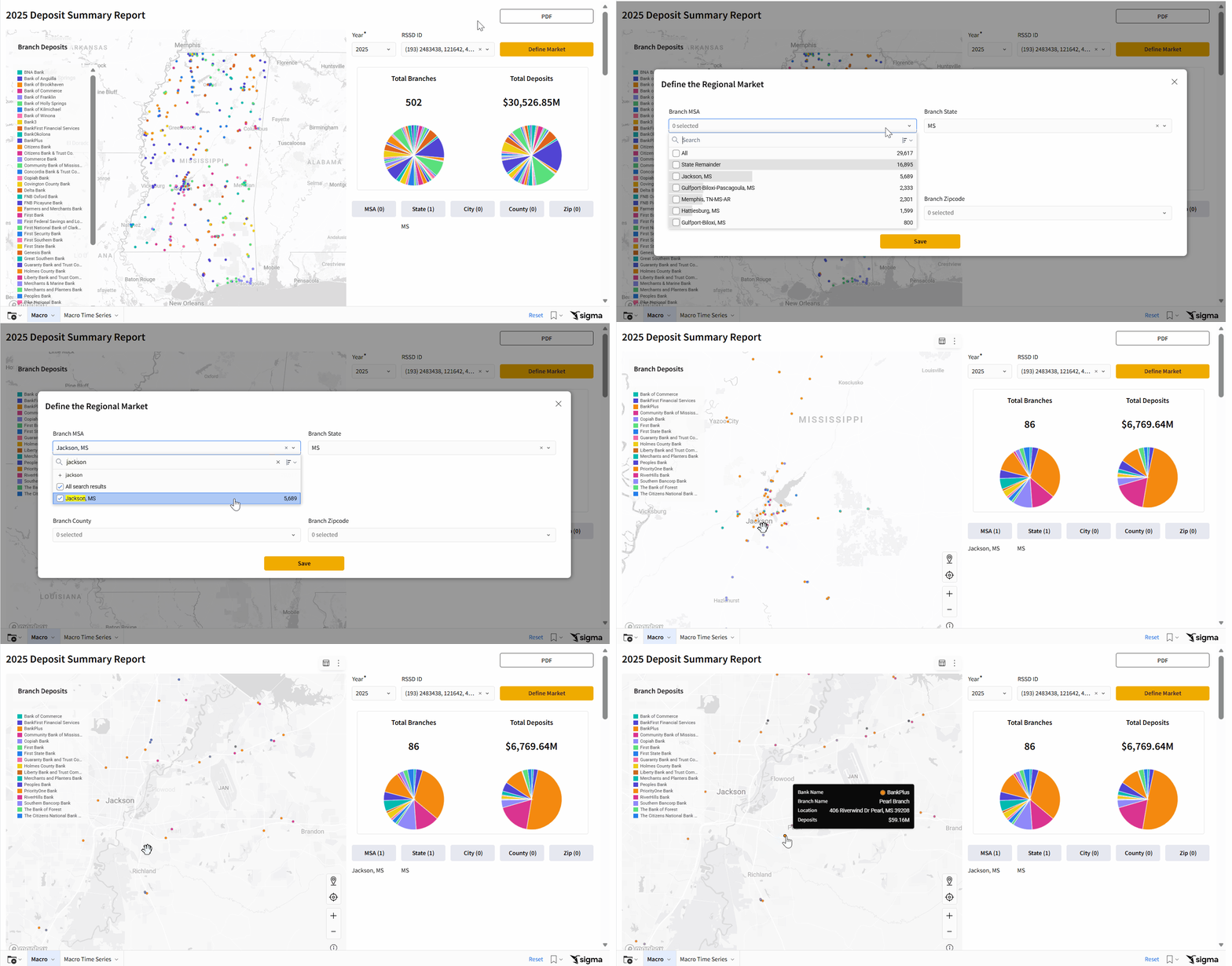
Although their borrower base often reflects weaker traditional credit metrics and greater geographic or sector concentrations, these risks are partially mitigated by conservative loan structures, credit enhancements, deep local knowledge, and historically stable deposit franchises, making CDFI banks a distinct segment of the banking industry whose structure, growth dynamics, and loan composition may warrant separate analytical consideration.

CDFI bank lending is largely concentrated in residential mortgage and commercial real estate (CRE) lending. Residential mortgage loans make up just under 30% of loans among the average CDFI-certified bank, whereas non-owner-occupied (NOO) and owner-occupied (OO) CRE lending are equivalent to 28.6% and 13.8%, respectively. An extended period of significant growth in U.S. bank residential mortgage lending–exceeding total loan growth across consecutive quarters spanning 1Q 2023-2Q 2024–likely played a role in CDFI banks’ strong asset growth over the past several years. As mortgage lending begins to rebound amid falling mortgage rates, it is possible growth at these banks will continue to exhibit resilience.
Connect with KBRA Analytics


805 Third Avenue
29th Floor New York, NY 10022
Copyright © 2017-2026 All Rights Reserved by KBRA Analytics, LLC. KBRA Analytics, LLC is not affiliated with Kroll Inc., Kroll Associates Inc., KrollOnTrack Inc., or their affiliated businesses.